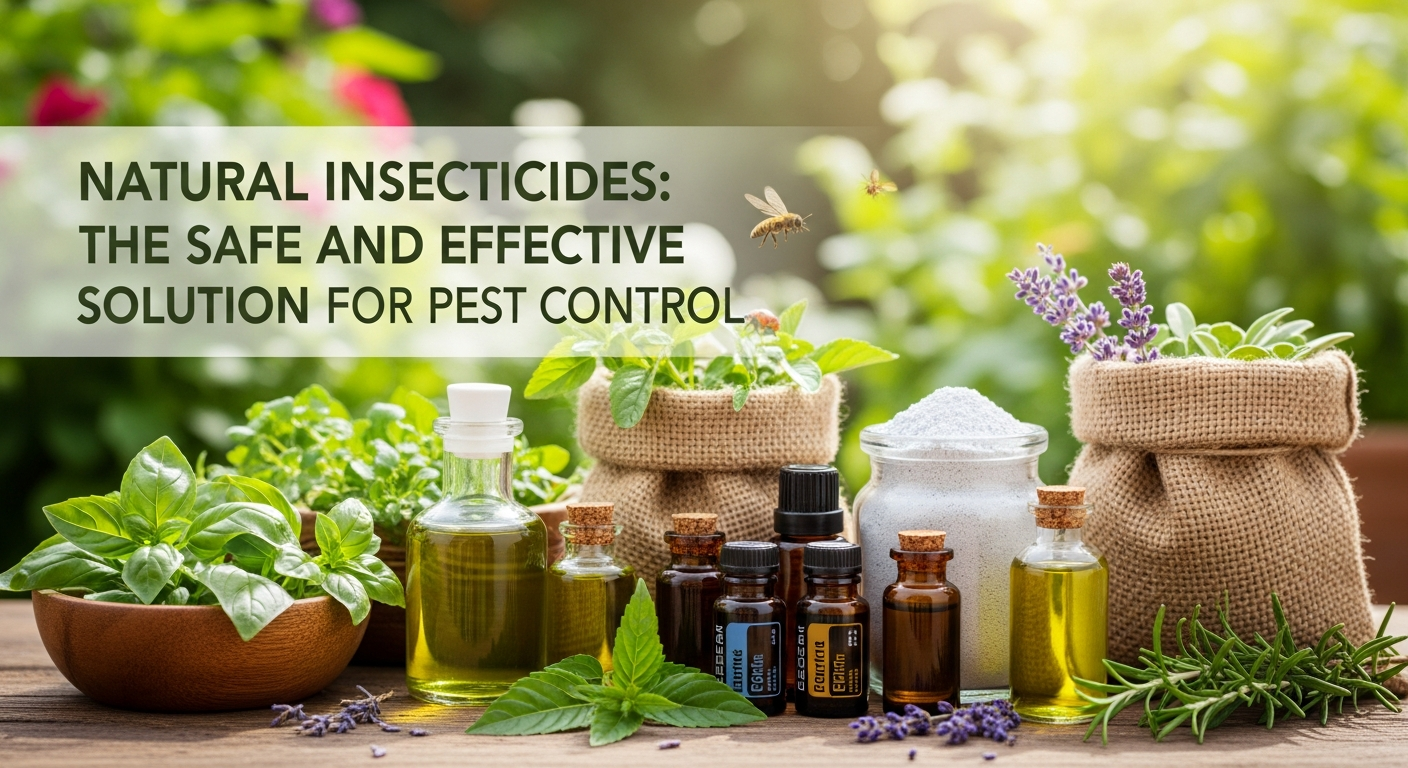
An 'organic' insecticide is an insecticide derived from natural products of plant, mineral and beneficial microbial mediums with natural ingredients and compounds. Natural insecticide products are safe and efficient for farmers to use for many decades, protecting their crops while enabling the clean growing environment of their soil and crops.
Examples of natural insecticides from the plant kingdom include essential oils, neem oil products, plant active ingredients, and microorganisms. All of these products are safe for crops to be used; however, they provide effective ways to eliminate the most damaging pests that destroy crops. When used properly, natural insecticide products leave minimal residue on crops as they decompose fast, so that crops can benefit from using insecticides with maximal health benefits.
A properly applied natural insecticide spray is a reasonable alternative to using synthetic chemicals for pest control in agricultural production, allowing farmers to manage pests with environmentally sustainable methods, protecting and sustaining the intelligence of their soil, and conserving valuable beneficial insects that would otherwise be killed by conventional chemical insecticides.
Understanding Natural Insecticides: What Are They and How Do They Work?
Pesticide use has been steadily growing in our society with pesticide chemical method usage, while additionally the natural insecticides are becoming more prominent as they provide safer, more sustainable solutions to pest management. The natural insecticides are derived from the extraction of minerals, plants and beneficial microorganisms to develop a solution for controlling pests that is more gentle on the crops and environment.
In agriculture the role of the natural insecticides are to be a major means of reducing residue levels, preserving and maintaining healthy soils and keeping ecological balance, as well as providing knowledge about the different attributes and how natural insecticides work, so that the farmers can apply them in integrated farming methods, as well as in organic farming methods.
Definition of Natural Insecticides
Natural insecticides are products that control insect populations using naturally derived sources.
- Derived from plants and minerals
- Provide alternatives for controlling insect populations without using chemical agents
- Have less of an effect on beneficial insects, crops and soils
- Are a common method used in organic farming and sustainable practices
Natural insecticides are pest-management products made from substances created by nature; e.g., neem, garlic, essential oils, and beneficial microorganisms. Natural insecticides are designed to keep pests away from agricultural products while having minimal environmental impacts.
How Natural Insecticides Affect Pests
Unlike chemical insecticides that control pests through toxicity, natural insecticides have an indirect approach to controlling insects through disruption of the insect's typical behavior.
How natural insecticides work on pests are some of these key points:
- Strong odors/tastes repel insects
- Disruption in feeding/reproduction cycle
- Disrupts insect's growth and development
- Causes dehydration or asphyxiation to soft-bodied pests

While natural insecticides work slowly on pests using indirect means, they are very efficient when used properly and do not damage crops or beneficial insects when used according to recommendations.
Role in Agricultural Pest Control
Natural insecticides are a critical part of managing agricultural pests sustainably.
- Can be used to treat vegetables, fruits, grains, and legumes
- Can be integrated into an Integrated Pest Management (IPM) program
- Can help slow down the development of resistance to pesticides
- Can improve soil health and therefore improve crop health.
Although most natural insecticides for agricultural applications are used to control aphids, mites, caterpillars, and other common pests, natural insecticides can be applied as foliar (foliar) sprays or applied to the soil as soil treatments. Many farmers are now utilizing natural insecticides and their compatibility with integrated pest management (I.P.M.) programs allow them to integrate cultural, biological, and mechanical pest control techniques together to reduce (chemical) pesticide dependence and promote (sustainable) long-term agricultural practices on their farms.
The Benefits of Using Natural Insecticides Over Chemical Alternatives
Natural insecticides have gained popularity among farmers who want to use a safer alternative to chemical insecticides when they are managing pest problems. Natural insecticides are derived from natural substances (such as plant extracts, minerals, or beneficial microorganisms) and are used to manage pests without negatively affecting the soil health, the crop, or the farm worker's health.
Farmers are adopting natural insecticides to make more eco-friendly choices when selecting pest control products because natural insecticides provide effectiveness without jeopardizing the farmer's future sustainability.
Reduced Toxicity and Health Safety
The most significant benefit associated with using natural insecticides is their lower toxicity levels than those associated with chemical insecticides.
- Healthier for the farmer and farm workers to use
- Lower potential for chemical residue on food crops
- Minimal impact on livestock or surrounding neighbours
- Reduced incidence of pesticide toxicity
Natural insecticides specifically target the pest being treated, and they do not harm human or animal populations when they are applied as directed. For instance, an insecticide that is made from neem, garlic, or essential oils gets absorbed quickly by the insect and does not leave much residue on the crop itself. Therefore, natural insecticides are the best choice for farmers who produce fruits and vegetables, as food safety is of utmost importance to these farmers..
Environmental Benefits in Agriculture
Farmers are recognizing the importance of environmental protection when switching to natural pest control products. Some of the benefits of using natural pest control products include:
- Will protect essential pollinators such as bees and their predators
- Will reduce soil/water contamination\
- Will not leave behind a lasting impact on the environment since they are biodegradabl
- Will promote biodiversity and ecosystem balance.
Chemical pesticides can persist in soil and water for long periods and may even affect off-target species. Natural insecticides, however, break down very quickly, meaning that their effects on the environment will be short-lived. As a result of applying natural insecticide sprays on crops, farmers are able to control pest populations without harming essential pollinators or beneficial insects.
Suitable for Sustainable and Organic Farming
Natural insecticides have become an essential element in the organic and sustainable agriculture community.
Some advantages associated with natural insecticides include:
- Approved for use in organic agriculture
- Support an Integrated Pest Management (IPM) Approach.
- Less dependence on chemicals
- Enhance the sustainability of farms long term.
Natural insecticides have become integral to sustainable and organic farmers of plant production to use additional methods of managing pest populations without using synthetic pesticides. Many farmers use methods of biological control, farming techniques of crop rotation, and cultural practices together with natural insecticides as part of the Integrated Pest Management (IPM) Program to maintain productivity and continue meeting consumer demand for clean, chemical-free food while also adhering to the Organic Certification process.

Top Types of Natural Insecticides Used in Agriculture
Over the last few years, natural insecticides have become an increasingly popular choice for modern agriculture as more farmers turn to safer, eco-friendly ways to control pests. Natural insecticides are derived from natural sources, and their application helps protect crops while maintaining soil health and promoting biodiversity.
Unlike chemical pesticides, which tend to be more aggressive in their approach to pest management, natural insecticides for plants are gentler but equally effective, making them ideal for use in sustainable agriculture systems.
Botanical and Plant-Based Insecticides
Botanical insecticides (botanicals) are insecticides that are made from specific species of plants known for their ability to repel or kill many different species of insects.
- Botanical insecticides are derived from plants such as neem, pyrethrum, garlic, and tobacco.
- Most botanical insecticides are effective against both sucking and chewing insects.
- Botanical insecticides are relatively safe for crops when used correctly.
- They break down very rapidly in the environment.
Botanical insecticides have been used by farmers for many years as part of traditional farming systems. An example is neem-based products. Neem-based insecticides work by interfering with insect feeding and reproduction, thereby reducing pest populations naturally. Botanical insecticides are commonly used by farmers to control aphids, caterpillars, and whiteflies in agricultural fields of vegetables, fruits, and grain. Because botanical insecticides are derived from living organisms, they are less harmful to beneficial insects, making them an excellent choice for organic farmers.
Mineral-Based Natural Insecticides
The most important thing about mineral insecticides is that they are naturally occurring minerals, which control pest infestation due to the physical properties and/or chemical components of the minerals.
- Mineral insecticides are made from minerals (e.g., Sulfur, Diatomaceous Earth).
- The action of mineral insecticides occurs by dehydrating and/or damaging the structure of the insect.
- Mineral insecticides provide an effective means of controlling pests, such as grain and field pests.
- The level of chemical residue from mineral insecticides is minimal.
Mineral insecticides are often regarded for their simplicity and effectiveness. Diatomaceous Earth destroys the outer protective layer of insects, which results in dehydration and eventually death of the insect.
Natural Oil and Essential Oil Sprays
Insecticides derived from natural oils are frequently used; they come in the form of sprays.
- They can come from neem, eucalyptus, citrus, and clove detergent oils
- They serve two purposes: to repel insects and to obstruct their ability to breath/feed.
- They are easy to use; they may be applied in the same manner as foliar products.
- They are intended for vegetables, fruits, and ornamental plants.
Natural oils provide a means of removing insects by blocking an insect's ability to breath or feed by creating an oil coating on the insect to keep them from breathing. Neem oil sprays are effective for aphids, thrips, and spider mites; these products can be regularly applied without negatively affecting the crop if used according to label directions.

Common Natural Insecticides for Plants and Their Uses
For many years (long before synthetic chemicals were created), natural pest management methods have been used in the growing of crops. Nowadays, the effectiveness of using natural insecticides for plants has increased due to their safety, eco-friendly properties, and the fact that they fit well within a framework of sustainable agriculture.
Neem Oil Insecticide
Neem Oil is one of the most used and effective natural insecticides in Agriculture.
- Extracted from the seeds of neem trees
- Controls chewing and sucking insects
- Acts as a deterrent, repellent, and growth regulator
- Safe for use on all crops and beneficial insects
Neem Oil controls the feeding and reproduction of pests, such as aphids, whiteflies, mites, and caterpillars. As a natural insecticide, Neem Oil prevents the laying of eggs by insects while inhibiting the growth of larvae. Neem oil is used extensively in both vegetable and fruit production, as well as in ornamental production because it quickly degrades with minimal residual impact. Because of the multiple modes of action with Neem Oil, this type of insecticide has proven to be effective for long-term pest management.
Diatomaceous Earth for Insects
Diatomaceous earth is a naturally occurring mineral insecticide that is primarily effective against crawling pests.
- It is composed of the remains of algae (diatoms) that have been buried for many years and changed into fossils.
- When applied to insects, diatomaceous earth injures the outer exoskeleton of the insect.
- Diatomaceous earth is most effective for controlling ants, beetles and soil dwelling pest.
- Diatomaceous earth is safe for use around humans and animals.
Diatomaceous earth's method of action is mechanical rather than chemical; it damages the outer skin of the insect when the insect walks on or comes into contact with the sharp diatomaceous earth particles, diatomaceous earth causes the insect to become dehydrated and die. For these reasons, diatomaceous earth is one of the best choices for use as a natural insecticide for plants, particularly for control of pests in the soil and storage.
Garlic and Essential Oil Sprays
Garlic and essential oils are also effective natural insect repellents due to their strong smell and bioactive ingredients.
- Contain a strong odor that repel insects
- Efficient against aphids, thrips and caterpillars
- Easily prepared and applied as sprays.
- Appropriate for organic and home gardening.
Garlic and essential oils repel insects by dissuading them from feeding on and/or settling on the crops as effective natural insecticide sprays.

How to Apply Natural Insecticides Effectively on Farms and Gardens
Most importantly, when choosing to use a Natural Insecticide, you must apply it correctly. How well and when you apply Natural Insecticides will determine how effective they will be as pest management tools on your crop(s). Additionally, when handled properly, Natural Insecticides do not harm beneficial insects and promote healthy soil for long-lasting benefits.
Proper Application Timing and Methods
There is nothing more critical to the successful application of Natural Insecticides than timing; therefore, please remember the following:
- The Optimal Time to Apply is Early Morning or Late Evening; do not apply in bright, direct sunlight
- Apply to Target Pest Life Stages, such as during early or late-season (Example: Larvae Stage of Insect)
- Always Check Weather/Rain Patterns (to avoid wash-off)
Natural Insecticides break down much faster than Synthetic Chemicals. The correct application timing and method will ensure that the Natural Insecticide stays active on the plant surface longer and does not cause crop damage due to thermal degradation.
Using Natural Insecticide Spray Correctly
Importance of Correctly Applying Natural Insecticides:
Correctly applying a natural insecticide provides for an even application and for optimum control of insect pests and disease.
- Always shake and mix well prior to spraying; spray all surfaces of the plant; only spray the infested areas of the plant that need to be sprayed
- Use a clean, and calibrated sprayer
- Never over-spray; using too much spray can cause plants to be burned/stressed.
Revised: To effectively apply a natural insecticide, it is best to do so as close as possible to where the insect or feeding site is located. Having a uniform coverage (across all surfaces) is especially important underneath leaves, where many insects tend to hide.
Storage and Safety Best Practices
Safety precautions protect the integrity of natural insecticides and also protect the user.
- Store natural insecticides in a cool, dry, dark place, away from direct heat and sunlight
- Label each container
- Keep containers out of reach of children/animals.
Revised: Although natural insecticides are generally considered safer than conventional chemical insecticides, it is essential to follow best practices for safe handling and storage when using natural insecticides. A natural insecticide's efficacy can be diminished by storing it at a high temperature and/or in direct sunlight; the potential for contamination also increases when natural insecticides are not stored/handled properly.

Challenges and Limitations of Natural Insecticides
Farmers appreciate the safety and environmentally sound characteristics associated with natural insecticides, as evident by their adoption in sustainable/organic agricultural systems. Farmers should keep in mind that natural products, like all other types of agricultural inputs, have inherent limitations, and each farmer should educate themselves on the limitations prior to using any insecticide products.
Slower Action Compared to Chemical Products
The inability to produce quick visible symptoms or fatality after application is one of the biggest challenges when first experimenting with natural insecticides.
- No immediate knockdown of insects occurs
- Gradual effects via inhibition of feeding or reproductive activity
- Repeated applications for best results
- Best utilized to control disease/pest infestations during the early stages of infestation
Natural insecticides do not kill or knock down the pest immediately. They defend plants and assist pest communities by reducing the degree of feed and/or facilitating reductions in the number of insects feeding (fertility and maturation). Therefore, farmers will not experience immediate fatality or symptoms, as is the case with chemical insecticides or their equivalent, after spraying a pest infestation. H3-Shorter Residual Effect
Slower Action Compared to Chemical Products
Limitations of using "natural" (organic) insecticides relate to the fact that they only last a limited time in soil and on crops.
- They decompose quickly with exposure to sun and rain
- They must be reapplied more frequently than synthetic pesticides
- They leave little risk of pesticide build-up on food crops
- They are eco-friendly but do not last as long.
The majority of natural insecticides produced in liquid form are biodegradable and break down quickly when exposed to the sun, rain, or humidity, and when subjected to microbe infestation. Although this is good for protecting the environment and maintaining food quality, it does mean that natural insecticides do not provide as long of a period of protection as do the majority of synthetic pesticides.
Pest-Specific Effectiveness
"Nebulous" (organic) insecticides typically are effective on only one type of pest, as opposed to being effective on many.
- They typically are effective on specific insects or life-stages of Cannabis flowers
- They generally do not provide sufficient levels of control for an insect that is present in multiple life-stages
- It is critical to correctly identify the infesting insects for the right pesticide to be selected
- They create little impact on other beneficial insects or non-target organisms.
Unlike many synthetic pesticides that are classified as "broad-spectrum" (meaning they perform well across all insects), most natural insecticides tend to be "narrow-spectrum", meaning they are effective against a selected number of insect pests. As such, natural insecticide products tend to work very well against a particular type of insect, yet they typically do not provide control over more than one life-stage of that pest. Therefore, Farmers need to accurately identify the infesting insect pests before selecting a particular natural insecticide for use against them.

The Future of Pest Control with Natural Insecticides
Natural insecticides are the key to creating a future based on environmentally safe, sustainable farming practices, as agriculture continues its move toward mechanical and chemical-free solutions. The increases in soil health awareness, concern for pesticide residue safety, and commitment to sustainable cropping systems are driving farmers away from traditional means of controlling pests with the use of chemical products.
By utilizing natural insecticides, farmers can eliminate harmful insect pests while also maintaining beneficial insects and improving soil quality.
Growing Demand for Chemical-Free Farming
The demand for chemical-free and low-residue farming systems continues to grow rapidly in every area of the agricultural industry.
- An increase in the number of consumers that are looking for organic and low-residue foods
- More awareness of soil health and the environment
- Reduction in the risk to farm workers and consumers from exposure to hazardous material
- More acceptance for exports and higher-priced markets
To stay ahead of the growing demand, more farmers are turning to natural insecticides. The application of natural resources to plant protection allows farmers to produce safe food for human consumption while protecting the ecological system around them. The application of natural plant protection products results in lower levels of toxic residues in crops and is an effective way to manage insect pest populations on fruits, vegetables, and leafy greens.
Innovation in Natural Formulations
Substantial innovations in the field of science are continually transforming traditional methods of biological pest control into more advanced, highly efficient biological pest control solutions.
- More Effective Formulations from Neem and Essential Oils and Microbes
- Extended Shelf Life and Stability of Natural Insecticide Sprays
- Targeting Specific Crop Pests with a Specific Mode of Action
- Enhanced Activity and Less Frequent Applications
Advancements in scientific research, along with new extraction techniques, have resulted in the creation of several powerful new formulations of natural insecticides for plants. New bio-enhancing technologies further enhance the efficacy of natural insecticides and improve safety. The additional new advances in natural insecticides provide a consistent level of effectiveness across different environmental conditions and plant growth stages and make it possible for growers to use natural solutions on a large scale.
Integration with Sustainable Agriculture
Natural insecticides will have the greatest benefit to users when they are incorporated into a larger system of sustainable agricultural practices.
- Natural insecticides will Complement IPM Programs
- Natural insecticides will support Beneficial Insects
- Natural insecticides will help to Increase Soil Fertility over time
- Natural insecticides will help Reduce the Development of Pest Resistance
Natural Agriculture will rely on Balance between Crop Protection and the Protection of the Environment. The use of natural insecticides fits into the system of IPM, crop rotation and biological control. Natural insecticides will not eliminate all insects but can support the management of the insect population naturally.

FAQs:
Q1. What are natural insecticides?
Natural insecticides are pest control products made from plant, mineral, or biological sources.
Q2. Are natural insecticides safe for crops?
Yes, they are generally safe when used correctly and do not harm plant growth.
Q3. Can natural insecticide spray replace chemical pesticides?
In many cases, yes especially when used as part of integrated pest management.
Q4. What are common natural insecticides for plants?
Neem oil, garlic extract, essential oils, and microbial solutions are commonly used.
Q5. How often should natural insecticides be applied?
They are usually applied at shorter intervals, as recommended on the product label.
Conclusion: Make the Switch to Natural Insecticides for a Healthier Home and Environment Today
By selecting natural insecticides, you can take action to improve the overall health of your Farming practices and your living environment. Natural insecticides are derived from Plants and microorganisms, allowing Farmers and Gardeners to manage the Pests that affect their Crops without utilizing heavy-duty chemicals that will impact the Soil, Crops, and Human Health.
In addition, Natural Insecticides promote Soil Health and are beneficial to Beneficial Insects such as Pollinators, while reducing Toxic Residue on Food products. As a result, Natural Insecticides are an excellent resource for Agriculture as well as Individuals who grow their own Food.
In addition, Natural Insecticides represent an opportunity to support a sustainable Future as Environmental Awareness increases.
When used properly, they provide Students of Pest Control with a Legacy of Ecosystem Balance and Long-Term Benefits.
Switching today protects your Crops and your immediate environment, while laying the groundwork for a Cleaner and Healthier Future for Others.