
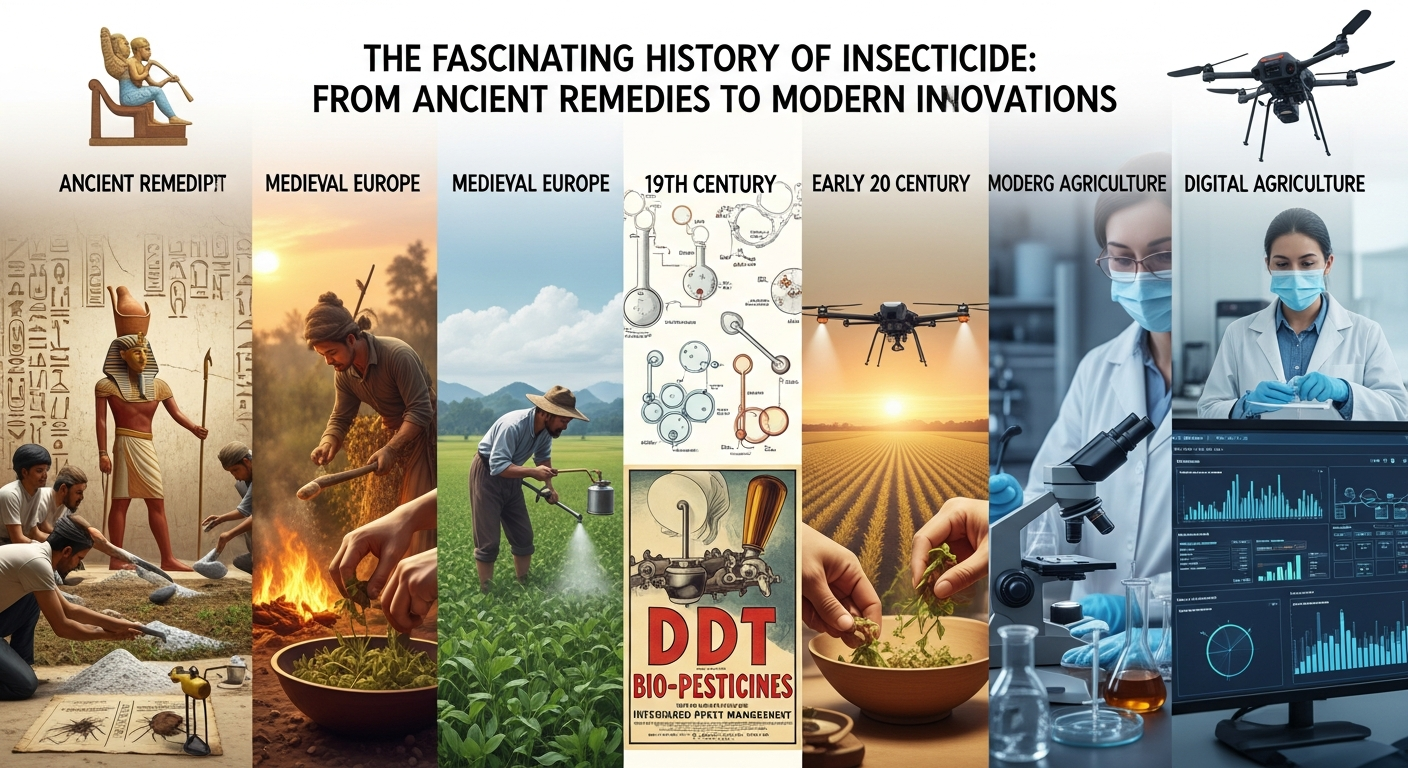
Historically, farmers have had insecticides at their disposal to help with pest control since the beginning of agriculture. This was due to the fact that insecticides prevent the damage caused by certain pests to the farm's crop. The tradition of using insecticides began with early farmers, who would use naturally occurring materials, like oils derived from plants, ash from plants, and mineral based products, as ways to stop insects from eating their crops and stored grain. The foundation of an entire industry was built upon these early agricultural practices using chemical methods. The insecticide business has changed as agriculture has expanded, and as a greater demand exists for food from society, new methods for controlling pest populations through the use of pesticides have been developed and improved over time through the scientific discoveries of today. The result of these advancements is the manufacturing and development of synthetic insecticides; therefore farmers can manage pest populations better and provide their farms with more produce (food) and have a decreased amount of crop loss from insects damaging their crops. It is important to continue to find the best way to develop new products and to maintain a healthy balance between modern production of food crops, worker safety, and protecting our environment. Therefore, we are in the process of developing biological-based insecticides along with precision application techniques, such as integrated pest management systems, in order to ensure that we can continue to have an abundant supply of food while protecting our environment for the future.
Early Beginnings: Ancient Methods for Pest Control
Insecticides date back to before modern chemistry when insecticide application was developed by traditional farming systems. While modern farmers utilize the principles of modern chemistry, ancient farmers developed insecticides through their natural knowledge of crops.
Insecticide development in earlier farming societies occurred through observation and experimentation with the behaviour of insects and by utilising available materials to deter pest damage. Although it was not referred to as such, these early methods of usage formed the basis for how insecticides are currently known.
Most of the methods of pest control in ancient societies were primarily preventative instead of curative and focused on repelling insects rather than eliminating them from crops. Insecticides developed using this method reflect the understanding of nature's importance, and the farmers need to protect their crops using natural resources long before the onset of industrial agriculture.
Natural Remedies in Ancient Agriculture
Ancient farmers employed natural products (plant-based and mineral) to fight off insects that invaded their fields and storage areas.
The Importance of Plant-Based Products for Insect Control
Some plant-based insect control products presented to ancient farmers included:
- Neem Tree, Garlic, Tobacco, Extracts of Herbs
- Other Natural Remedies for Insect Control Utilised by Ancient Farmers
- Ashes and Lime (to be applied to the soil surrounding the crop and also to the crop)
- Oils and Resins to Repel Insects from Growing Plants

Traditional Pest Prevention Practices
Throughout history, it has been possible to physically and culturally prevent pest infestation, and traditional farmers have always relied on physical and cultural methods of controlling pests rather than chemical means.
Key Points:
- To stop the life cycle of a pest, crop rotation was common practice.
- Intercropping was also very popular because it confused or repelled insects.
- Farmers used smoke to ward off pests through the burning of crop residue.
- To prevent storage pests from eating away at their grain, many farmers sun-dried their grain.
Most traditional farming systems relied heavily on prevention, rather than chemical means, to control pests. The use of smoke and heat to protect grains stored as ``treasure'' was a common practice among most ancient farming societies, along with alternating planting times and mixing crops, in order to minimize damage from insects. The concept of naturally controlling pests by using these types of methods was an essential part of developing the first pesticides used for agriculture.
Historical Importance in Farming
During ancient times, pest control methods were imperative for the survival of man and to ensure food security in a society where the agricultural way of life was the primary means of obtaining food.
Key Points:
- Farmers protected staple crops from losing a substantial amount of their harvest.
- Farmers maintained quality seed for planting the following year.
- Farmers supported stable food supplies for their entire community.
The Rise of Chemical Insecticides in the 19th and 20th Centuries
Between the end of the 1800s up to the end of the 1900s, the development of how people manage insect damage changed vastly. Where agriculture began with reliance on natural sources of control (i.e., plant extracts and other parts of the plant), agricultural chemical management began. This growth in agriculture was partly due to the population growth, which created an increased demand for food and a resulting increase in the area of land to produce crops. Farmers and ag scientists created a need for better ways to kill the pests that were causing damage to crops.
Both industry and science continued to advance and make it possible to extract, process and manufacture insecticides in bulk. These developments enabled farmers to be able to produce larger quantities of crops while decreasing the amount of lost crops due to insect damage. However, while the introduction of chemical insecticides was increasing agricultural efficiency, it also created new problems regarding: the safety of farm workers, concerns for the environment and the longevity of these products.
Early Chemical Discoveries
- Historically, chemical insecticides began with scientists experimenting with naturally occurring chemical and mineral sources.
- Significant facts include: the earliest chemical insecticides consisted of those derived from minerals, such as sulfur compounds, arsenic compounds and the combination of copper with sulfur, which are known as the earliest chemical insecticides.
- Chemical insecticides were being utilized by growers to protect the upper portions of plants from insect attacks, and as a result, growers were able to expect more reliable outcomes from chemical insecticides than from those derived from plants.
DDT and Synthetic Breakthroughs
The use of chemical insecticides has significantly contributed to the rise of industrial farming. By controlling and managing pest outbreaks, chemical insecticides enabled the creation of mono-crop farming systems at large scales; ultimately resulting in higher yields of feed grains and significant efficiencies in current farming practices.
Important Points
- The use of chemical insecticides has helped to create and maintain large-scale mono-crop farming systems.
- By reducing the need for manual labour to manage crop pest insect populations, chemical insecticides have helped to lower labour costs associated with managing these pests.
- The widespread use of chemical insecticides has also created a growing amount of uncertainty concerning their long-term effects on the environment, increasing resistance to their use
Impact on Industrial Agriculture
The invention of chemical insecticides greatly affected agriculture and public health during the middle of the twentieth century.
Important Points
- DDT was one of the earliest and most successful synthetic insecticides.
- DDT has demonstrated efficacy against many different kinds of pest insects.
- DDT contributed significantly to increased agricultural productivity and reduced insect-borne disease transmission.
The introduction of DDT by the mid 1940's represented one of the most significant developments in the history of insecticides. Its ability to provide an effective, durable barrier for both agricultural pest management and controlling the spread of disease made DDT an immediate success in both agriculture and public health. While the introduction of DDT represented a significant breakthrough moment in the history of insecticides, this breakthrough also illustrated how the development of new chemicals through innovation could dramatically decrease crop losses from insect pest outbreaks and better secure global food production systems. these concerns led to limitations and ultimately bans of DDT, resulting in changes in the types of insecticides that are developed today.

The Impact of Insecticides on Agriculture and Public Health
Historically, the development of insecticides has had a major influence on agricultural growth and the welfare of people over the last several thousand years. Insecticides, as an agricultural solution to controlling insect populations that harm crops or spread disease, have been used from the beginning of agriculture until to the present time.
Insecticides are an important agricultural tool due to their ability to increase agricultural productivity, protect the general public's health from insect-borne illness, and stabilize the global food supply as agriculture has grown to meet the increasing demand for food.
Over the years, the development of insecticides has progressed from using very simple, or natural, products to increasingly sophisticated insecticide products through scientific advances. This progression has helped agriculture develop, both by decreasing the number of agricultural losses and providing the means to produce food on a large-scale basis, as well as providing significant contributions to public health programs that treat insect-borne diseases.
Crop Yield Improvement
The first major way insecticides influence agriculture is through agriculture. An important positive impact of insecticides is on improving agricultural productivity.
Key Points
- They protect crops against insects that feed on the leaves, stems, roots, and grains of the crop.
- They prevent yield losses due to the presence of pests.
- They maintain a healthier growing condition for crops throughout the entire period of growth.
- They allow farmers to grow larger quantities of crops in a shorter period of time.
Over time, the development of insecticides has had an enormous positive influence on agricultural yields. Farmers have been concerned about pest-related threats that could eliminate their crops for as long as farming exists. Prior to the discovery of effective insecticides, there were no ways to control pest threats; thus, agricultural productivity was severely limited and only a small percentage of household income would come from agriculture. This increased agricultural productivity lies at the heart of both agricultural expansion and economic security for rural farm communities.
Public Health Advancements
The use of insecticides has also contributed significantly to public health benefits, outside of their agricultural applications.
Summary of Key Points:
- Controls and eradicates insects known to transmit disease (mosquitoes and flies)
- Helps to minimize the spread of infectious diseases, including malaria, dengue and other vector-borne illnesses
- Provides enhanced sanitation for agricultural and rural communities
- Provides support for large and small public health initiatives at the local, national and global levels.
The history of insecticides is intertwined with significant public health advancements throughout history. The reduction of incidences of fatal diseases through use of insecticides in the mosquito control programs has contributed greatly. By controlling the populations of insects that live in proximity to agricultural areas, we can provide protection not only to the farmers but to the people who live in the areas surrounding the farms and thereby contribute to a healthier environment for everyone in that agricultural setting.
Food Security Growth
Insecticides are important for food security, which is one of the longest-lasting benefits from the history of the use of insecticides.
Important Points:
- Continued year-on-year reliable crop production
- Less waste associated with post-harvest storage and transport
- Availability of stabilizing food systems
- Growing global populations.
Insecticides protect crops not only in the field, but also after the harvest. Developed insecticides helped protect against food spoilage due to insect infestation of stored grain, resulting in less waste and reduced potential for food shortages. As insecticides progressed through time, the ability to effectively eliminate pests with insecticides allowed for stable and reliable sources of food. Currently, insecticides, when used correctly and in conjunction with sustainable agriculture, continue to be a large part of existing food security systems.

Environmental Concerns and Regulatory Changes Over Time
The Evolution of Insecticides from Natural to Synthesized. As developing countries used natural products as pesticides at first, they developed synthetic pesticides in the latter half of the 20th Century and the emergence of Synthetic Pesticides led to concerns about the environmental effects these chemicals would have on the environment, wildlife and crops. As the use of synthetic pesticides became more widespread, farmers began to see that these chemicals not only worked but also provided unintended consequences to their soils, wildlife, and beneficial insect populations. The concern over the long term environmental effects of pesticides changed the overall focus from solely on effectiveness to include both safe and sustainable.
Increased Awareness = Additional Scientific Research, Public Discourse, and Regulation. The greater awareness of the negative impacts of pesticides has led to the development of more balanced and responsible science-based approaches to pesticide use.
Environmental Impact Awareness
Link Between Environmental Awareness and Pesticide Use. Increased awareness is the result of having used pesticides at so many levels of agriculture, which has generated some discussion regarding their effects on the environment.
- Contaminated Soil and Water Supplies
- Beneficial Insect Population Declines
- Chemical Bioaccumulation in Food Chains
- Negative Long Term Effects on Ecosystems
Rachel Carson and Silent Spring
Important Points.
- Brought the public's attention to the environmental effects of uncontrolled pesticide use.
- Raised the awareness among people about the damage that pesticides do to the environment.
- Suggested that people consider the long-term consequences of applying chemical pesticides.
- Raised awareness of the global movement of environmentalists.
Silent Spring helped raise public awareness of the scientific evidence that shows that pesticides do harm to the environment. The book explained how pesticide applications affect birds and other animals and the entire ecosystem, and it therefore challenged the assumption that all chemicals are safe to use. This landmark publication in the history of pesticides led many in government, agriculture, and academia to examine their use and practice of pesticides, and to lay the foundation for the establishment of environmental protection regulations for pesticides.
Regulatory Evolution
As society learned more about the use of pesticides, governments adopted laws to regulate the production and use of pesticides.
Important Points.
- Developed ways to establish an approval process for pesticides
- Established bans or restrictions on the use of certain highly toxic pesticides.
- Developed guidelines for the safe use of pesticides for farmers.
- Provided support for developing and using safer pest control alternatives (IPM).

Regulatory changes in the pesticide industry ushered in a new era for pesticides. Government agencies began to evaluate the products based on their toxicity, their duration of time they persist in the environment, and their potential health effects. While many pesticide products were restricted or banned for use, others were encouraged to use safer pesticide formulations. The effects of pesticide regulation and use have helped move agriculture toward sustainable pest management methods that enable pesticide products to provide protection for crops through the continued use of pesticide products.
The Evolution Toward Safer and Sustainable Alternatives
Concerns regarding the environmental and human health safety of agricultural insecticides are only continuing to grow over time as the insecticide history continues to unfold. Although chemicals applied via its application process made for effective pest management, many limitations arose from the heavy pesticide use including resistance build-up and negative environmental impacts prompting scientists, farmers and government agencies to reconsider how they produce/manufacture and apply insecticides in agriculture.
So far, as the history of insecticides has progressed, the trend has been to develop and promote safer and more sustainable methods of insecticides such that they provide for effective pest management and also support the stewardship of the environment. As the process of developing insecticides continues to evolve, the emphasis has shifted from extremely broad spectrum extremely toxic (highly toxic) to providing protection to crops via the use of a variety of new technologies and products to keep soils healthy, preserve beneficial insect populations and to maintain as high a level of biodiversity as possible. The evolution of the use of biorational insecticides, integrated pest management (IPM) systems and sustainable agriculture practices illustrate this transition.
Biorational and Biological Insecticides
Biorational and biological insecticides represent the next major milestones in the development of insecticides.
Key Features
- Derived from natural materials like plants, bacteria and fungi
- Target specific insect species with minimum effect on beneficial insect species
- Break down quickly in the environment;
- Leave a minimal amount of chemical residue on food products’
Biorational insecticides are insecticides that use natural substances or microorganisms to present a pest-inactive version of the insecticide. Some examples of these types of products include neem-based formulations and microbial agents. These products operate in a manner where they have a specific activity on a target life stage of the insect, making them less harmful to crops and other organisms. This change from broad use of chemical insecticides to a treatment method that reflects the principles of Integrated Pest Management (IPM) supports sustainable agriculture.
Integrated Pest Management (IPM)
Integrated Pest Management is a comprehensive and strategic use of multiple control methods (i.e. not just the use of chemical insecticides) to manage pest populations.
Summary of IPM:
IPM includes the following:
- Biological Control Methods (biological agents)
- Cultural Methods (practices, methods)
- Mechanical Control Methods (physical barriers, hand killing)
- Chemical Control Methods (insecticides)
- IPM uses chemical insecticides only when pest levels exceed economically viable levels
- The use of IPM greatly reduces the potential for pest resistance to develop.
- IPM promotes the continued efficiency of long-term pest control.
IPM has become an important part of modern insecticide history. Through this approach, farmers reduce the amount of chemical insecticides used on their farms, carefully monitoring the abundance of pest populations and only applying chemical insecticides as necessary. The practice of IPM promotes balanced and sustainable pest management, protecting beneficial insects and soil organisms.
Sustainable Agriculture Practices
Sustainable agriculture can work with modern insecticides to protect crops while preserving the health of the ecosystem.
Here are some important points to consider:
- Crop rotation is used to interrupt pest life cycles.
- Utilizing resistant crop varieties is an effective way to combat pest pressure.
- Creation of habitat for beneficial insects should be an ongoing effort in productive agricultural production.
- To reduce the reliance on chemical sprays, we must use integrated pest management.
Sustainability has become the overarching concept and focus of the later parts of the history of insecticides. By combining good agricultural practices with selected insecticides, farmers are able to maintain their production costs lower, preserve their soil health, and keep insecticides as effective options and not resorting to overuse.

FAQs
Q1. What is the history of insecticide in agriculture?
The history of insecticide began with natural pest control methods and evolved into chemical and biological solutions to protect crops.
Q2. Why were insecticides developed?
They were developed to control crop-damaging pests and prevent major agricultural yield losses.
Q3. How did DDT influence insecticide history?
DDT marked a major shift by providing powerful pest control but later raised concerns about environmental and health effects.
Q4. Are insecticides still important today?
Yes, insecticides remain essential for protecting crops and ensuring food security when used responsibly.
Q5. What are modern alternatives to traditional insecticides?
Modern alternatives include biological insecticides, biorational products, and Integrated Pest Management (IPM) practices.
Conclusion: Learning From the Past to Shape the Future of Pest Control Solutions
From rudimentary natural remedies to today's technologically advanced solutions, insecticide development has undergone considerable change over time. The examination of how people historically employed insecticides has allowed both farmers and researchers to gain an extensive awareness of effective methods, negative outcomes associated with some practices, and reasons for changing particular techniques. By understanding what has been done previously, farmers will avoid making the same mistakes they made previously (i.e. putting too much faith in one specific product) and make improved choices regarding pest control and management. The historical insights into the evolution of pest control techniques have allowed modern-day agriculture to enhance the development of effective methods to manage crop damage and pest invasions, understanding what has worked and what has not worked over time. Currently, there is an observable trend toward utilizing biologically based products (known as biopesticides), implementing Integrated Pest Management (IPM), and supporting sustainable practices that enable the agriculture industry to maintain crop yields without compromising environmental or human health. The lessons learned from history demonstrate that successfully managing pest damage incorporates not only removal of pests but also maintaining a balanced and self-sustaining ecology within our food production systems.
To move ahead towards sustainable pest control, we must combine new ideas with our responsibility towards continued pest control development in these areas. The research that leads to innovations in pest control will occur through ongoing studies of what we know and will continue to educate our farmers, while also continuing to have sustainable agricultural practices that allow the effective use of pesticides in disease prevention and as a source of danger. With the benefit of studying history and learning from it, agricultural producers and all those in agriculture can work together to create a better tomorrow by helping to provide better food for the world through a positive approach to agriculture, protecting our environment and ensuring that food is available to all people.